Agileday MCP for sales and staffing: Faster decisions, better delivery outcomes

Use Case: Responding to a client’s talent request in minutes
A customer reaches out: “We need someone with these skills. Can they start in two weeks?”
For sales, this moment matters. Speed often decides whether the deal moves forward, or doesn’t.
The old way
The salesperson has to figure it out:
- Message internal channels
- Wait for replies
- Search across tools
- Try to piece together availability, skills, and experience
Even with a system in place, it takes time. And the answer is often incomplete or delayed.
With MCP
The salesperson copies the client request into their AI tool. Within seconds, they get:
- A shortlist of relevant profiles
- Real availability
- Matches based on both structured data (skills) and unstructured data (CV history, past projects)
Not just who fits on paper — but who actually fits the exact need.
What happens next
The salesperson selects the best candidates.
From there:
- Profiles are formatted and ready to share
- A response email is drafted automatically
- The client gets a clear answer: Yes, we can help. Here’s who. Here’s when.
All within minutes of receiving the request.
Take a look:
Why it matters
This isn’t just about convenience.
It’s about:
- Responding before competitors do
- Showing confidence in delivery
- Turning inbound demand into actual revenue as fast as possible
Because in sales, speed isn’t a nice-to-have. It wins deals.
Use Case: Optimizing staffing scenarios and consultant rotations
In professional services firms, staffing is rarely a simple matching exercise. Every staffing decision impacts multiple parts of the business at once: delivery continuity, consultant happiness, utilization, future staffing flexibility, customer outcomes, and ultimately revenue and margins. But many staffing processes still rely heavily on manual coordination, isolated decisions, and operational guesswork.
When a new project opportunity appears, the challenge is often not simply finding someone on the bench. The right person may already be allocated elsewhere. Another consultant may be looking to rotate off a project. A delivery team may need backfilling. And operations teams need to balance all of this without disrupting ongoing customer work.
The old way
Traditionally, staffing managers coordinate these decisions manually through:
- Slack messages
- Phone calls
- Spreadsheet reviews
- Separate staffing meetings
- Searching across systems for availability and skills
- Trying to evaluate delivery impact across multiple projects at once
Even with modern operational platforms, staffing workflows are often handled one allocation at a time. The result is reactive decision-making, slower staffing responses, unnecessary bench time, and missed opportunities to better align consultant preferences with customer demand.
With Agileday, staffing teams can already:
- View consultant availability
- Identify people who want to rotate
- Search for skills and competencies
- Match supply and demand
- Manage staffing allocations directly inside the platform
But more complex staffing decisions still require humans to manually evaluate multiple scenarios and operational tradeoffs.
With MCP
With Agileday MCP, staffing and delivery teams can evaluate staffing scenarios conversationally through tools like ChatGPT, Claude, Copilot, or Slack. Instead of manually navigating systems and coordinating discussions across teams, the staffing manager can simply ask: “Who could fill this new Scrum Master opportunity?” or “Are there consultants currently looking to rotate who could fit this project?”
Agileday MCP already understands:
- Current allocations
- Consultant availability
- Rotation preferences
- Skills and competencies
- Historical project experience
- Future staffing demand
- Organizational operational data
The AI can then identify potential staffing scenarios, explain why certain consultants may be a fit, evaluate replacement options, and help operations teams understand the broader delivery impact of different decisions.
For example:
- A consultant looking to rotate off an existing customer project may be identified as a strong fit for a new opportunity
- The AI can then identify a suitable replacement for the original project
- Staffing managers can evaluate multiple possible allocation scenarios before making a decision
Because Agileday already connects staffing, projects, allocations, people data, and financial context together, the AI is not operating in isolation. It understands the operational reality of the business.
This moves staffing beyond simple supply-and-demand matching toward broader operational optimization.
Take a look:
Why it matters
This is not just about making staffing workflows faster. It is about helping firms optimize complex operational systems more intelligently.
For firms, that means:
- Faster staffing decisions
- Reduced bench time
- Better delivery continuity
- More proactive staffing operations
- Improved utilization visibility
- Better alignment between consultant preferences and customer demand
- Reduced operational friction for staffing and delivery teams
For consultants, it means their development interests and rotation preferences can become a more active part of staffing decisions, instead of remaining disconnected from operational planning. And because staffing decisions also directly impact utilization, revenue, and margins, AI-assisted scenario planning can help firms make more informed operational and financial decisions at the same time.
This is where operational AI becomes more than automation. It becomes a way to optimize how professional services organizations operate as interconnected systems.
How MCP makes this possible
Agileday already connects the operational core of your business: people and competences, sales pipeline, staffing, projects, time reporting, financials. Agileday MCP is the layer that makes all of it accessible to AI in a permission-aware way.
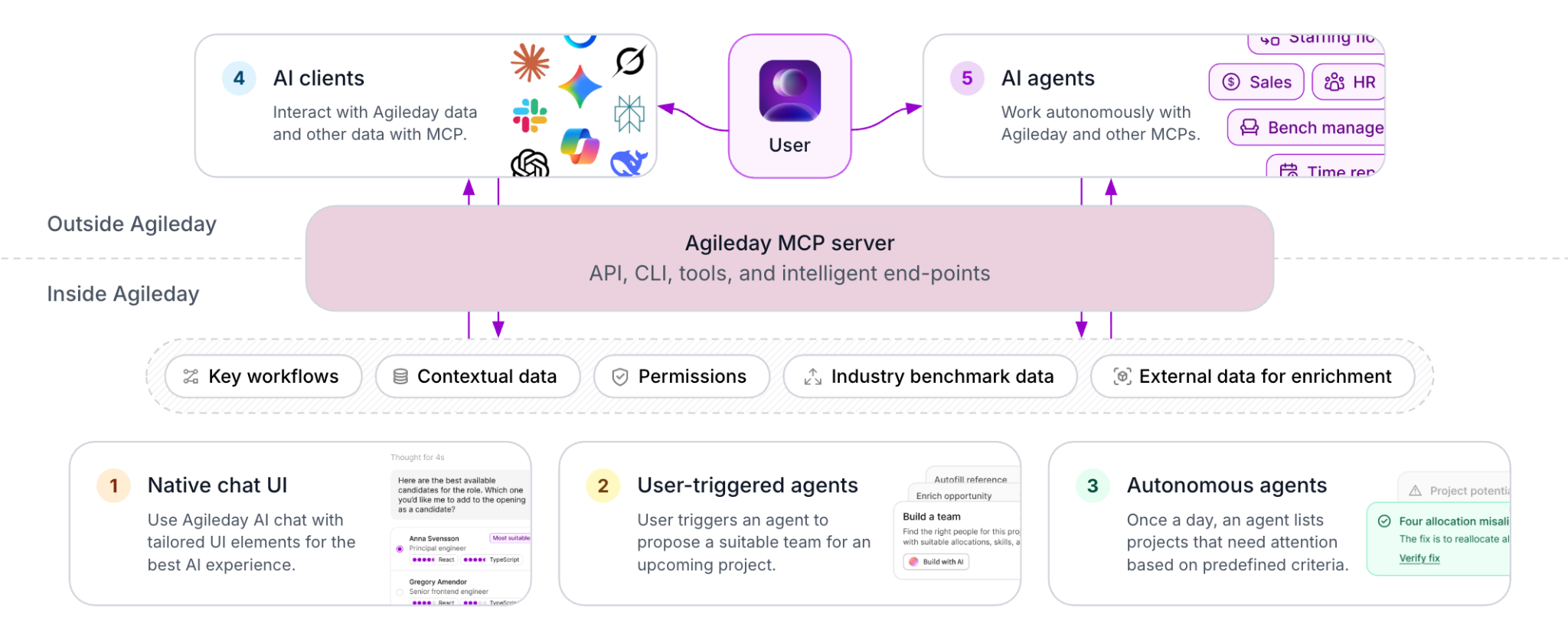
Instead of navigating systems manually, users can interact with operational data using natural language. AI can retrieve the right information, combine structured data such as skills and availability with unstructured data such as experience and project history, and return outputs that are immediately usable. At the same time, these interactions can trigger actions directly, such as creating shortlists, drafting communications, updating records, or progressing workflows without requiring separate manual steps.
For automation and agents, you can also connect your custom agents or Slack bot to Agileday MCP, to run recurring tasks or react to events in your HR, CRM or financial tools. In addition, as more tools adopt MCP, you can build overarching workflows across multiple systems.
Get in touch to meet our team for a walkthrough to see how the Agileday MCP can reshape how your firm operates.
Let the Agiledays begin.